

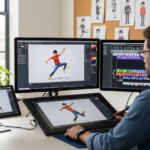




Canada’s visual effects industry is experiencing unprecedented growth, with the sector expanding by 17% annually and creating thousands of new opportunities for skilled artists and technicians. Vancouver alone hosts over 60 VFX studios, including major players like Industrial Light & Magic, Digital Domain, and MPC, making Canada one of the world’s premier destinations for VFX education and career development.
For international students seeking to enter this dynamic field, navigating the application process to Canadian VFX academies requires careful planning and attention to multiple requirements. This comprehensive checklist covers the essential steps: researching top institutions like Vancouver Film School (VFS), Seneca College, Toronto Film School, and VanArts; meeting academic and portfolio requirements; demonstrating English proficiency; and securing study permits. Early application is crucial, as processing times can extend several months, and popular programs fill quickly.
Research Top Canadian VFX Academies
Canada’s leading VFX schools are concentrated primarily in Vancouver and Toronto, each offering distinct advantages for international students. Vancouver Film School stands out for its industry connections and accelerated programs, while Seneca College’s Visual Effects for Film and Television program provides comprehensive technical training. Toronto Film School offers integrated approaches combining traditional filmmaking with digital effects, and VanArts specializes in hands-on learning with small class sizes.
When evaluating programs, consider factors such as curriculum focus (whether 2D compositing, 3D animation, or motion graphics), industry partnerships for internships and job placement, and the specific software and techniques emphasized. Most programs range from 12 to 18 months for diploma programs, with some offering shorter certificate options for students with existing experience.
Vancouver vs Toronto VFX Hubs
| School | Location | Key Programs | Intl Support |
|---|---|---|---|
| Vancouver Film School | Vancouver, BC | VFX & Animation, Game Design | Dedicated international office |
| VanArts | Vancouver, BC | Visual Effects, 3D Animation | Small class mentorship |
| Seneca College | Toronto, ON | VFX for Film & TV | Comprehensive student services |
| Toronto Film School | Toronto, ON | VFX Production, Game Design | International admissions team |
Program Duration and Costs Overview
Most VFX diploma programs in Canada run for 12-15 months, designed as intensive, career-focused training that gets students job-ready quickly. Tuition typically ranges from $28,000 to $45,000 CAD for international students, with most schools requiring a deposit of approximately $7,000 CAD upon acceptance to secure your spot and begin the study permit application process.
Additional costs to budget include living expenses ($15,000-20,000 CAD annually), textbooks and software licenses, and equipment. Many schools offer payment plans and some provide opportunities for part-time work during studies, though international students are limited to 20 hours per week during academic sessions.
Academic and Portfolio Requirements
- High school diploma or equivalent, or students must be 19 years or older for mature student admission
- Program-specific portfolio demonstrating artistic ability and technical skills
- Academic transcripts with minimum grade requirements (typically 60-70% average)
- Statement of purpose or personal essay explaining career goals
- Foundation year programs available for students lacking prerequisite art/technical background
- Some programs require specific courses like mathematics, physics, or art credits
Building a Strong VFX Portfolio
- Review specific portfolio requirements for your target program, as they vary significantly between 2D compositing, 3D animation, and motion graphics tracks
- Include 10-15 pieces showcasing both traditional art skills (drawing, painting, sculpture) and digital work if you have experience
- Demonstrate understanding of fundamental principles like perspective, lighting, color theory, and composition through diverse media
- Create original work rather than copying existing designs; schools value creativity and personal artistic voice
- Seek feedback from current students, graduates, or industry professionals before submitting
- Document your creative process with sketches, iterations, and artist statements explaining your approach
- Ensure technical quality by using high-resolution images and professional presentation formatting
English Language Proficiency Standards
Canadian VFX academies require demonstrated English proficiency through standardized testing, as coursework is intensive and technical. Different programs may have varying requirements, with more advanced or shorter-duration programs typically requiring higher scores. Students who don’t meet direct entry requirements can often gain conditional acceptance through English as a Second Language (ESL) pathway programs.
Most schools accept multiple testing options and some offer alternative pathways for students who have completed previous education in English. Score requirements are typically non-negotiable, but schools may consider the most recent test results and some accept super-scoring from multiple test dates.
| Test | VFS Level 1 | VFS Level 2 | Seneca/TFS Min |
|---|---|---|---|
| IELTS Academic | 5.5 overall | 6.0 overall | 6.5 overall |
| TOEFL iBT | 68 overall | 79 overall | 84 overall |
| Duolingo | 95 overall | 110 overall | 115 overall |
| CAEL | 50 overall | 60 overall | 70 overall |
| Cambridge English | 162 overall | 169 overall | 176 overall |
| PTE Academic | 42 overall | 53 overall | 58 overall |
ESL School Partners for VFS
| School | Level 1 Req | Level 2 Req |
|---|---|---|
| ILAC Vancouver | Level 3.2 completion | Level 3.3 completion |
| EC English Vancouver | Pre-Intermediate | Upper-Intermediate |
| VGC International College | Level 5 completion | Level 6 completion |
| Kaplan Vancouver | Higher Intermediate | Advanced level |
| St. George International | Level 4 completion | Level 5 completion |
| Pacific Link College | EAP 4 completion | EAP 5 completion |
| Global Village Vancouver | Level 6 completion | Level 7 completion |
| LSI Vancouver | Intermediate completion | Advanced completion |
Alternatives to Standardized Tests
Students may qualify for English language requirement waivers through several alternative pathways. Completion of International Baccalaureate programs with English instruction, graduation from secondary school in English-speaking countries, or completion of post-secondary education where English was the language of instruction may satisfy requirements.
Some schools also accept completion of specific English courses from recognized institutions, or successful completion of their own English placement tests administered during campus visits or online interviews. These alternatives require official documentation and may involve additional assessment processes.
Credential Evaluation for Qualifications
International transcripts and diplomas typically require formal evaluation to ensure equivalency with Canadian educational standards. World Education Services (WES) and International Credential Assessment Service (ICAS) are the most widely accepted evaluation services for Canadian institutions, providing detailed reports that translate foreign credentials into Canadian equivalents.
The evaluation process can take 6-8 weeks, making early application crucial for meeting program deadlines. Some schools may accept preliminary evaluations for initial admission decisions, but final evaluations are typically required before program commencement.
When and How to Get WES/ICAS
- Choose between WES ($267 CAD) or ICAS ($200 CAD) based on your school’s preference and processing times
- Request official transcripts and certificates directly from your educational institutions to be sent sealed to the evaluation service
- Submit your application online with required documentation and payment, ensuring all documents are in English or officially translated
- Allow 6-8 weeks for processing, though expedited services are available for additional fees
- Request reports be sent directly to your target schools and keep copies for your study permit application
Study Permit and Visa Application Process
- Receive Letter of Acceptance (LOA) from a Designated Learning Institution (DLI) and pay required tuition deposit
- Gather required documentation including passport, financial proof, medical exams, and police certificates as needed
- Complete online application through Immigration, Refugees and Citizenship Canada (IRCC) portal
- Pay application fees ($150 CAD for study permit, plus biometrics fee $85 CAD)
- Submit biometrics at designated collection points within 30 days of request
- Attend visa interview if requested by your local Canadian consulate or embassy
- Monitor application status and respond promptly to any requests for additional information
Required Documents for Study Permit
| Document | Details | School-Specific |
|---|---|---|
| Letter of Acceptance | Official LOA from DLI with program details | Must show tuition deposit paid |
| Proof of Financial Support | $30,000+ CAD for tuition plus living expenses | Bank statements, sponsor letters |
| Valid Passport | Valid for program duration plus 6 months | Biographical pages copy |
| Statement of Purpose | Study plans and career goals | Explain choice of program/school |
| Medical Examination | Required for some countries | Designated panel physician |
| Police Certificate | Background check from residence countries | If lived elsewhere 6+ months |
Common Pitfalls and Timelines
Study permit processing times vary by country but typically range from 2-12 weeks, with peak application periods during spring and summer causing delays. Avoid booking flights or making firm travel arrangements until your permit is approved, as processing times are estimates and can extend significantly during busy periods.
Common application pitfalls include insufficient financial documentation, unclear study plans, or missing signatures and dates on forms. Ensure all supporting documents are recent (within 6 months for financial statements), properly translated if needed, and clearly demonstrate your intent to return home after studies.
Application Submission Steps
| Step | VFS Process | Toronto Film School | VanArts |
|---|---|---|---|
| Application Fee | $150 CAD | $75 CAD | $100 CAD |
| Portfolio Submission | Online platform required | Upload through applicant portal | Digital portfolio review |
| Transcript Requirements | Official transcripts mandatory | Sealed official transcripts | Direct institutional submission |
| Interview Process | Portfolio review meeting | Optional admissions interview | Required portfolio presentation |
| Decision Timeline | 2-4 weeks post-submission | 3-6 weeks for review | 1-3 weeks notification |
Post-Acceptance Actions
- Pay tuition deposit (typically $7,000 CAD) within specified deadline to secure enrollment
- Sign enrollment agreement and review all terms and conditions carefully
- Schedule advisor meeting to discuss course planning, housing, and orientation details
- Begin study permit application immediately using Letter of Acceptance
- Register for orientation sessions and complete any required pre-program assignments
- Arrange housing either through school partnerships or independent research for off-campus options
Health Insurance and Financial Proof
All international students in Canada require comprehensive health insurance coverage, as provincial health care plans typically exclude temporary residents. Most schools offer mandatory health insurance plans ranging from $600-1,200 CAD annually, covering basic medical services, emergency care, and prescription medications. Students may be able to opt out if they can demonstrate equivalent private coverage.
Financial proof requirements extend beyond tuition costs to include living expenses, typically requiring evidence of $15,000-20,000 CAD annually depending on the city. Documentation must show readily accessible funds, not just accumulated wealth, and may require explanation letters for large deposits or financial gifts from family members.
Proof of Funds Checklist
- Bank statements covering 4-6 months showing consistent balances and transaction history
- Sponsor letters from family members or guardians guaranteeing financial support with their bank documentation
- Investment statements or fixed deposit certificates demonstrating additional accessible funds
- Educational loan approval letters from recognized financial institutions with disbursement terms
- Scholarship or grant award letters specifying amounts and payment schedules for program duration
Final Pre-Departure Checklist
The final weeks before departure require careful attention to documentation, practical arrangements, and administrative requirements. Students should organize essential documents in easily accessible formats, both physical and digital copies, and ensure all permits and authorizations are current and properly validated.
Travel preparations should include confirming arrival logistics, temporary accommodation if needed, and understanding entry requirements at Canadian ports of entry. Many students benefit from connecting with current students or alumni for practical advice about settling into Canadian life and academic culture.
| Item | Required For | Notes |
|---|---|---|
| Study Permit & Passport | Border entry | Carry originals plus copies |
| Letter of Acceptance | Immigration verification | Must match study permit details |
| Health Insurance Cards | Medical emergencies | Coverage starts immediately |
| Financial Documentation | Immigration questions | Bank statements, sponsor letters |
| Accommodation Confirmation | Address verification | Temporary or permanent housing |
| Academic Transcripts | School registration | Original plus certified copies |
| International Driver’s License | Transportation needs | Valid for first 3 months |
Arrival Essentials
Prepare comprehensive medical records including vaccination history, prescription medication lists, and any ongoing treatment documentation for continuity of care in Canada. Establish access to international banking services or credit cards with low foreign transaction fees, and notify your bank of travel plans to avoid card blocks.
Research local transportation options, currency exchange, and immediate needs like grocery shopping and phone service setup. Consider bringing essential electronics with appropriate adapters and ensure important contacts and school information are easily accessible during travel.
Ongoing Support from Schools
Canadian VFX academies provide comprehensive support services throughout the program duration, including academic advisors who monitor progress and assist with course planning. International student services offer specialized assistance with immigration questions, work permit applications for post-graduation opportunities, and cultural adjustment support.
Career services departments maintain industry connections for internships and job placement, often continuing support for graduates seeking employment. Many schools also facilitate student networks and alumni connections that provide ongoing professional development opportunities within Canada’s thriving VFX industry.